Top Emergency Plumbers in Rush, OH, 45648 | Compare & Call

There are 239 plumbing companies server in Rush OH
Morgantown's Plumber is your trusted local plumbing expert serving Morgantown, WV, and the surrounding areas. We specialize in a comprehensive range of services, from faucet and toilet repairs to full...
Appalachia Handyman Services
Appalachia Handyman Services has been serving the Rachel, WV community with reliable home improvement solutions for over two decades. Founded in 2016 after working alongside an experienced contractor ...
Affordable Plumbing in Farmington, WV, is a trusted local plumbing service dedicated to helping homeowners and businesses with a wide range of plumbing needs. Serving the Farmington community, we spec...

Speedway Appliance
Speedway Appliance has been a trusted name in Clarksburg since 2001, dedicated to providing affordable, guaranteed appliance solutions. We offer the largest local selection, including brand-new and re...

Drain Works is your trusted Wheeling plumbing specialist. When clogs or leaks disrupt your home, we provide same-day service to restore your peace of mind. Our team brings deep expertise and specializ...
Prime Plumbing is a trusted local plumbing and remodeling contractor serving Moundsville, WV, and surrounding areas. With years of experience, we specialize in a comprehensive range of services includ...
Ruckman Plumbing and Electrical
Ruckman Plumbing and Electrical is your trusted local expert serving McMechen, WV, and surrounding areas. We specialize in solving the common plumbing issues that homeowners face, such as pipe corrosi...
Dave's Plumbing Service
Dave's Plumbing Service has been a trusted provider of residential and commercial plumbing solutions in the Triadelphia, Wheeling, Moundsville, and St Clairsville areas for many years. We are a fully ...
A E Pelley Plumbing & Heating is a trusted, locally-owned plumbing service in Wheeling, WV, dedicated to keeping homes and businesses running smoothly. We specialize in thorough plumbing inspections t...
For over eight years, I've dedicated myself to the plumbing trade in the Upper Ohio Valley. What began as helping friends and neighbors with side jobs grew so consistently that by 2019, I made the dec...
Estimated Plumbing Costs in Rush, OH
Frequently Asked Questions
Could the flat land around Rush affect my sewer line?
The relatively plain terrain means drainage relies on proper grading and pipe slope. If the soil around your foundation or septic field has settled over time, it can create a low spot that puts reverse stress on your main sewer line. This can lead to sagging, known as a 'belly,' where waste and solids collect instead of flowing freely. It's a common issue we check for near older homes, especially after heavy rains when the flat ground holds water.
Who handles the permits for a major plumbing repair in Scioto County?
Any repipe or sewer line replacement requires a permit from the Scioto County Building Department. As a master plumber licensed by the Ohio Construction Industry Licensing Board, I pull those permits, schedule the required inspections, and ensure the work meets all current code. My crew handles that red tape so you don't have to navigate the county offices, and it guarantees the work is documented for your home's records.
How fast can a plumber get to my house in Rush?
From my shop, a typical dispatch route heads past Rush Township Hall onto US-23. That main artery provides reliable access throughout the township. For most service calls in the area, you can expect a truck on-site within 45 to 60 minutes, barring any major roadwork or weather delays on the state route.
Are plumbing issues different for rural homes with wells and septic?
Absolutely. A rural system is self-contained. A leak or pressure drop isn't just an inconvenience—it risks running your well pump dry or overloading your septic drain field. For instance, a constantly running toilet can pump hundreds of gallons into the septic tank, causing a premature failure. Diagnostics always have to consider the entire system, from the well pressure tank and switch to the septic tank's inlet and outlet baffles.
Does having a private well make my plumbing problems worse?
Private wells supply unsoftened, mineral-rich water directly into your home's system. This hard water accelerates scale buildup inside pipes, water heaters, and fixtures. In a water heater, that scale acts as an insulator, causing the unit to overwork and fail prematurely. For fixtures, it clogs aerators and valve seats, leading to drips and low flow. Installing a whole-house water softener is often a critical investment to protect new plumbing after a repipe.
Why are my water pipes suddenly failing in my Rush home?
Homes built here in the late 1950s, like many around Rush Center, used galvanized steel pipe. Installed around 1959, that pipe is now 67 years old. The zinc lining that prevents rust has completely worn away, and the bare steel inside is actively corroding. Homeowners are now seeing widespread pinhole leaks, joint failures, and severely restricted water flow as the internal diameter closes up with rust scale.
What's the most important spring plumbing maintenance for this area?
The spring thaw, after our winter lows around 20°F, is the peak season for water line issues. A key pro-tip is to inspect the exterior hose bibbs and the main water line entry point into your foundation for any new moisture or settling that occurred over the freeze-thaw cycles. Catching a minor leak at a bibb washer or a slight shift in your main line early can prevent a major rupture when the ground is fully saturated and unstable.
What does a galvanized steel pipe failure look like?
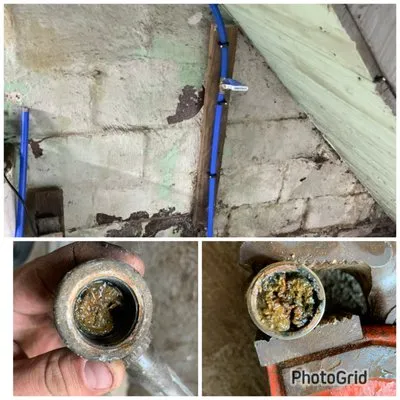
The most common failure for 1959-era galvanized pipe is joint calcification and pinhole leaks. Decades of hard water deposit minerals, which fuse with the corroding steel at threaded joints, effectively cementing them shut. This makes spot repairs impossible, as trying to unscrew a fitting often cracks the brittle pipe. A full section replacement, using modern materials with dielectric unions to prevent galvanic corrosion, becomes the only permanent fix.
